7-oh dosage guide, 7-hydroxymitragynine safe use, kratom extract harm reduction, 7-oh side effects
The market for specialty botanical extracts has expanded dramatically. Among these, 7-Hydroxymitragynine (7-OH)—the highly potent alkaloid isolated from the Mitragyna speciosa (kratom) plant—has captured widespread attention.
While many users seek out 7-OH for intense physical comfort, mental clarity, and relaxation, it is crucial to understand that 7-OH is fundamentally different from traditional raw kratom powder. Because of its unique pharmacology and high concentration, using 7-OH safely requires a strict commitment to harm reduction, precise dosing, and an understanding of its potent effects.
This guide offers a transparent, scientifically grounded framework for approaching 7-OH responsibly.
Understanding 7-OH: Why It’s Not “Just Kratom”
To use 7-OH safely, you must first understand what it is. In raw kratom leaves, 7-hydroxymitragynine occurs only in trace, microscopic amounts. However, modern extraction techniques isolate and concentrate this compound into standalone tablets, liquid shots, and powders.
From a biological standpoint, 7-OH acts as a highly selective agonist of the brain’s mu-opioid receptors. Because of this binding affinity, 7-OH is estimated to be significantly more potent than mitragynine (kratom’s primary alkaloid) and carries a vastly different pharmacological profile.
Because commercial 7-OH products contain levels of the compound that far exceed what you would naturally ingest from raw leaves, it must be treated with the same respect and caution as any other highly concentrated, active compound.
The 7-OH Dosage Framework: “Start Low, Go Slow”
Because 7-OH is so concentrated, the margin between an effective serving and an uncomfortable experience is narrow. If you are a beginner or are transitioning from standard kratom extracts, you must adopt a conservative, measured approach.
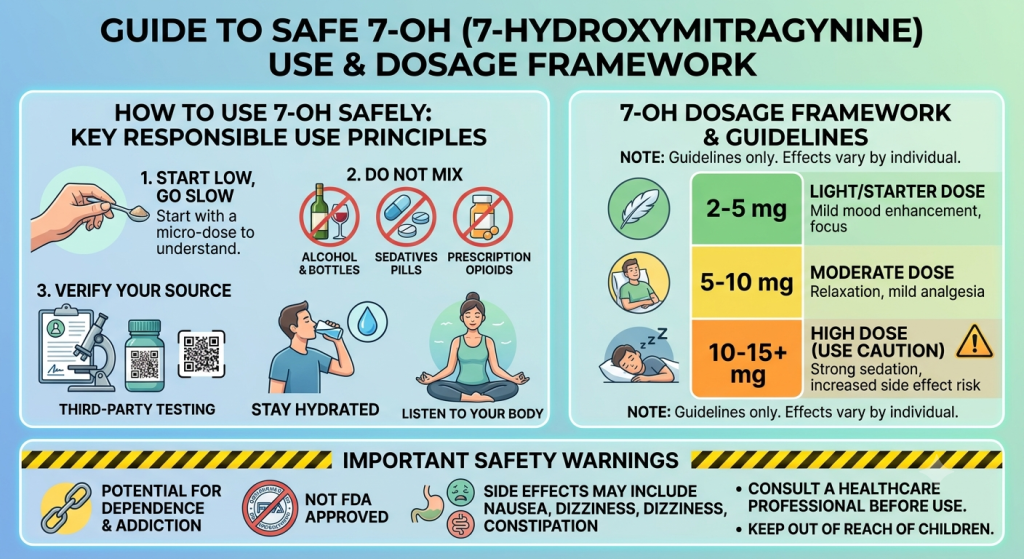
The following table outlines a conservative baseline dosage guide based on average industry observations.
Important Note: There are no FDA-approved therapeutic guidelines or standardized medical dosages for 7-OH. The table below is intended solely for educational purposes and to prevent accidental overconsumption.
| User Level | Suggested Serving Size (mg) | Format Reference | Primary Objective |
| Beginner / Sensitive | 1.5 mg – 3 mg | 1/6 to 1/4 of a standard 14mg tablet | Assess individual tolerance and baseline physiological response. |
| Moderate User | 3 mg – 7 mg | 1/4 to 1/2 of a standard 14mg tablet | Steady relaxation and moderate physical comfort. |
| Experienced | 7 mg – 15 mg | 1/2 to 1 full standard 14mg tablet | strong calming effects. Compulsive redosing beyond this range drastically increases risks. |
Practical Dosing Tips:
- Do Not Take the Whole Tablet: Most commercially available 7-OH tablets contain between 10mg to 15mg of active compound. Never consume a whole tablet on your first attempt. Use a pill cutter to split it into quarters.
- Track Your Intake: Keep a written log of the exact milligram strength you ingest and the time of consumption.
- Allow Ample Time for Onset: Depending on the delivery method (chewable tablet, liquid shot, or sublingual strip), onset can take anywhere from 15 to 45 minutes. Wait at least 2 hours before evaluating whether you need to adjust your serving.
Recognizing Key Side Effects and Risks
Part of using any active botanical safely is knowing what to look out for. While 7-OH is widely used for its relaxing properties, exceeding safe thresholds or using it too frequently can result in adverse effects.
Common Acute Side Effects:
- Nausea and Vomiting: A highly common reaction if the dose is too high.
- Dizziness and Vertigo: A feeling of instability or lightheadedness.
- Excessive Sedation: Severe drowsiness that can impair your ability to function.
- Impaired Judgment: Slower cognitive response times and motor coordination.
Long-Term Risks:
- Rapid Tolerance Development: The body adapts to 7-OH incredibly quickly. If you use it daily, you will rapidly require larger doses to achieve the same effects.
- Dependence & Withdrawal: Because of its heavy activity on mu-opioid receptors, abrupt cessation after prolonged use can trigger withdrawal symptoms. These typically manifest as severe anxiety, insomnia, irritability, and gastrointestinal distress.
Critical Safety Boundaries and Rules
To practice true harm reduction, there are several hard boundaries you should never cross when using 7-hydroxymitragynine.
Rule 1: Never Mix with Other Depressants
Because 7-OH has a sedative profile, combining it with other Central Nervous System (CNS) depressants is extremely dangerous and increases the risk of respiratory depression. Do not combine 7-OH with:
- Alcohol
- Benzodiazepines or prescription sleep aids
- Other opioids or heavy sedatives
Rule 2: Limit Frequency of Use
To prevent rapid tolerance and physiological dependence, do not make 7-OH a daily habit. Treat it as an occasional, situational supplement. Incorporating regular “washout” periods (several consecutive days of zero use) helps keep your body’s receptors reset.
Rule 3: Avoid Operating Machinery
Because 7-OH can cause sudden sedation, dizziness, and motor impairment, do not drive a vehicle or operate any dangerous machinery while under its influence
The 2026 Regulatory Landscape & Sourcing Safely
As of July 2026, the legal status of 7-OH has shifted heavily. The U.S. Drug Enforcement Administration (DEA) filed its intent to temporarily place highly concentrated, synthetic 7-OH products (above a certain threshold, typically 1mg per serving or 0.05% by dry weight) into Schedule I of the Controlled Substances Act.
Furthermore, states like California and Kansas, alongside local municipalities (like Spokane, WA), have actively moved to ban or heavily enforce restrictions on concentrated 7-OH formulations to protect consumers from unregulated or adulterated products
For consumers seeking natural, plant-derived options, this means sourcing transparency is more important than ever. If you choose to purchase botanical products, ensure the brand:
- Publishes up-to-date, independent, third-party Certificates of Analysis (COAs) to verify purity and ensure the product is free from harmful heavy metals, pesticides, or residual solvents.
- Does not add synthetic or artificially boosted levels of 7-OH to its formulas.
- Complies fully with standard supplement packaging guidelines, displaying clear batch numbers and ingredients.
Standard Disclaimer
These statements have not been evaluated by the Food and Drug Administration (FDA). 7-Hydroxymitragynine has not been approved for medical use, and these products are not intended to diagnose, treat, cure, or prevent any disease. Always consult with a qualified healthcare professional before introducing new active compounds into your routine. Do not consume if you are under the age of 21.